Examples
The DynGPT framework is capable of efficiently solving the stationary distribution of state transition networks (STNs) and inferring static data to obtain the parameters of their underlying STNs. The modeling process of STN involves the following steps:
Define the state vector \(s\left( t \right)=\left( {{s}_{1}},\ldots ,{{s}_{M}} \right).\)
Identify the set of events \(\mathcal{R}=\left\{\left. {{\mathcal{R}}_{1}},\ldots ,{{\mathcal{R}}_{K}} \right\} \right.,\) specifying delayed events as needed.
Assign state changes per event \({{\Delta }^{\left(k\right)}}=\left(\Delta _{1}^{\left( k \right)},\ldots ,\Delta _{M}^{\left( k \right)} \right)\) to each event.
Define the propensity functions \({{\lambda }_{k}}\left(s;{{\theta }_{k}} \right)\) governing the rates of stochastic events.
Under this framework, the system’s state \(s\left(t \right)\) at any time \(t>0\) can be written as
where \({{R}_{k}}\left( t \right)\) are counting processes that depend on the occurrence propensity and count occurrences of the \(k\text{-th}\) event \({{\mathcal{R}}_{k}}\) up to time \(t.\) We demonstrate the application of DynGPT in solving and inferring STNs using the following example:
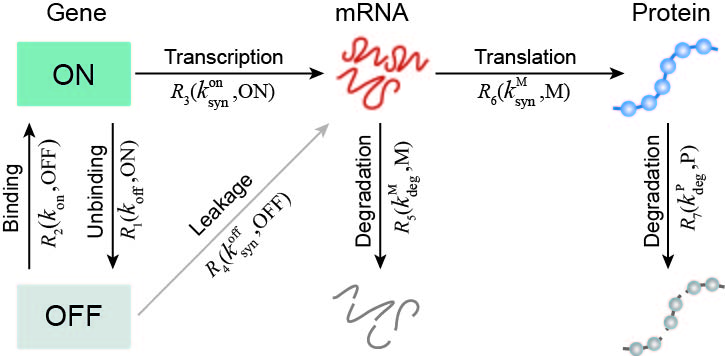
Gene expression model |
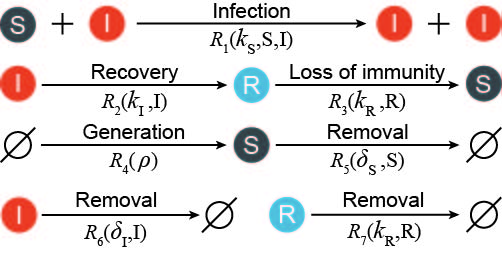
Epidemic model |
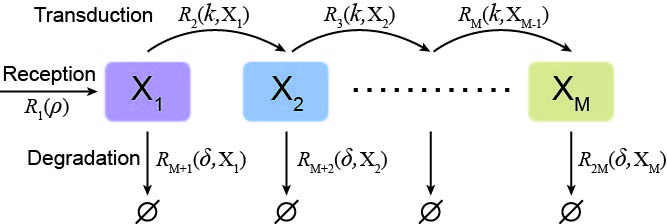
Signaling cascade model |
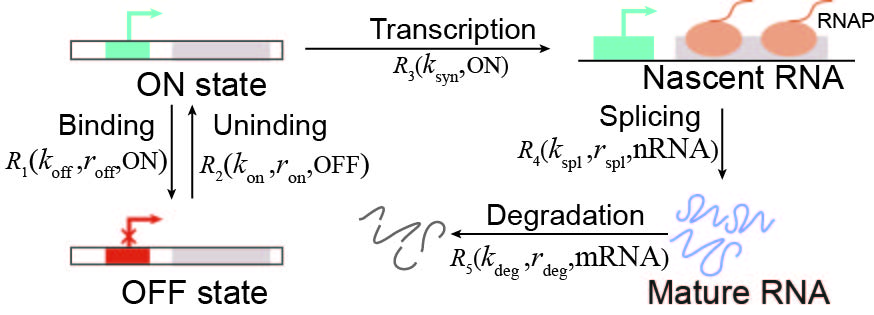
Non-Markovian RNA splicing model |